
DHI vs. FUE Hair Transplant: Which One Should You Choose?
For many people struggling with hair loss, a hair transplant is the most effective and permanent solution. However, when it comes to the actual procedure, patients are often faced with a difficult choice: FUE (Follicular Unit Extraction) or DHI (Direct Hair Implantation).
Which method is right for you? What are the fundamental differences between DHI and FUE? Here is our comprehensive guide to help you make an informed decision.
What are FUE and DHI? The Main Differences
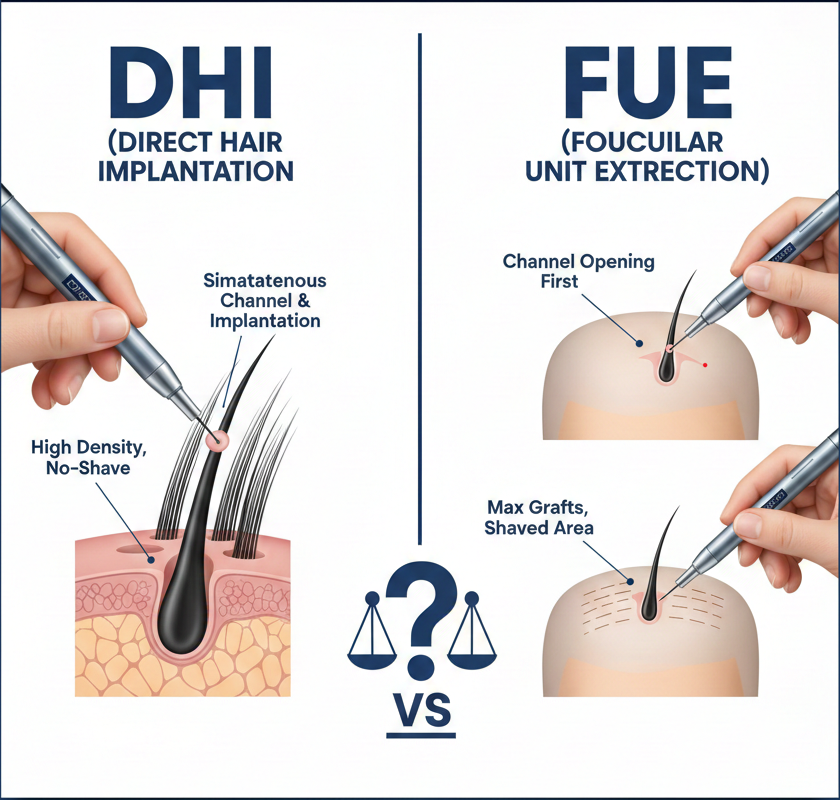
The core of both methods is the same: hair follicles (grafts) are extracted one by one from the donor area (usually the back of the head). The primary difference lies in how these follicles are implanted into the recipient area.
1. What is FUE Hair Transplant?
In the FUE method, the process consists of three stages: extraction, creating micro-channels (incisions) in the recipient area, and then placing the follicles into those channels.
Advantage: Allows for a high number of grafts (4000-5000+) to be transplanted in a single session.
Ideal Candidates: Those with extensive hair loss who want maximum density in one go.
2. What is DHI Hair Transplant?
In the DHI method, a specialized medical tool called a “Choi Implanter Pen” is used. Channel opening and follicle implantation happen simultaneously. The grafts are loaded into the pen and injected directly into the scalp.
Advantage: Enables higher density between existing hairs and often eliminates the need to shave the entire head.
Ideal Candidates: Those with thinning hair, individuals looking to lower their hairline, or women/men who prefer not to cut their hair short for the surgery.
4 Critical Criteria for Your Decision
When determining which method is best for you, specialists generally look at these four factors:
| Criteria | FUE Method | DHI Method |
| Area of Baldness | Ideal for large bald areas. | Best for regional thinning and adding density. |
| Graft Count | Up to 5000 grafts in one session. | Usually limited to 2500-3500 grafts. |
| Recovery Time | Fast, but scabbing occurs over a larger area. | Minimal bleeding, extremely fast recovery. |
| Shaving Requirement | Generally requires a full head shave. | Offers “No-Shave” transplant options. |
How is the Decision Made?
During your consultation, your doctor will consider the following factors to recommend a technique:
The Degree of Baldness: If the crown and frontal areas are completely open, FUE is often the more logical choice for cost-effectiveness and speed.
Desired Density: If you need to transplant between existing hairs, DHI is preferred as it causes the least trauma to surrounding tissue and allows for easier control of hair direction.
Budget: The DHI method is typically more expensive than FUE due to the specialized equipment and the longer duration of the procedure (requiring more precision and labor).
Social Return: If you need to “return to work the next day” and don’t want it to be obvious that you had a procedure, DHI is the superior option.
Conclusion: Which One is Better?
In reality, there is no “best method,” only the “best method for you.” Both techniques have success rates over 95% when performed by experienced professionals. The most important factors are the quality of your donor hair and your doctor’s surgical planning.
Expert Note: A hair transplant is a personalized design. You should not focus solely on the method without a professional analysis of your donor area capacity and hair structure.
Frequently Asked Questions (FAQ)
Is DHI more expensive than FUE? Yes, DHI is usually higher in price because of the technology used and the more time-intensive nature of the procedure.
Does DHI look more natural? Both methods provide natural results. However, because the Choi Pen gives the surgeon more control over the angle and direction of hair growth, DHI is often praised for creating a very natural-looking frontal hairline.
How long does the operation take? FUE usually takes 6-8 hours, while DHI may take slightly longer or be spread over two days depending on the number of grafts.
Would You Like a Free Hair Analysis? If you are wondering which method is most suitable for your hair structure, you can get an expert opinion by sending us your photos.